Field Note
Every test you have paid for should be written down in one place

Glen Mascall Founder of Trace
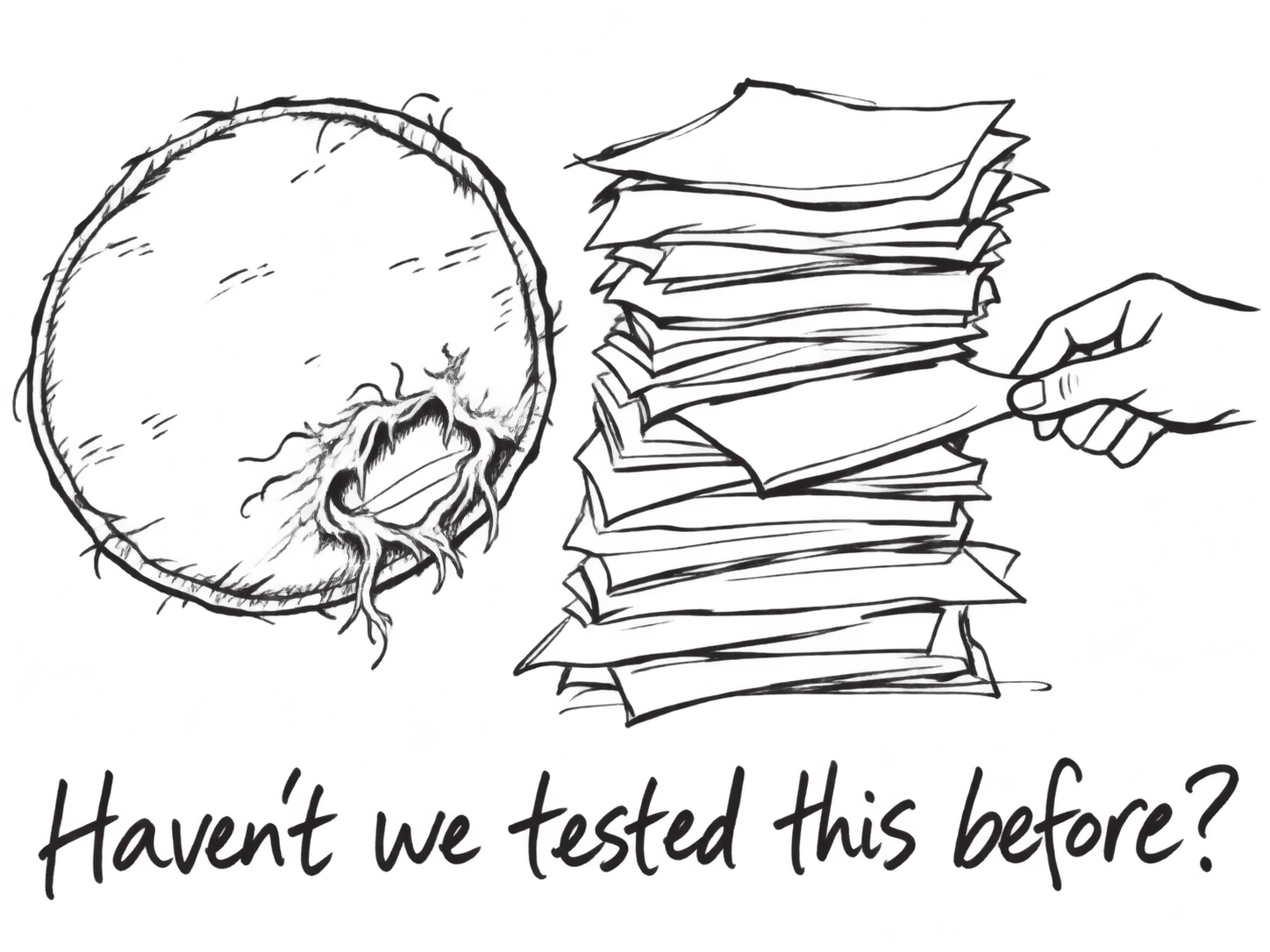
You have had that shell fabric tested before. You are fairly sure of it. The report went round by email a couple of seasons ago, and the factory cannot find its copy either. The samples for the new jacket need to go in, so you pay for the test again.
I have seen brands end up there more than once. They were sure the report was in their emails somewhere, but it was not logged anywhere, and it did not turn up before the deadline came round.
One log, every test
I call it a material matrix. It is one log of every material and construction you have had tested, whoever arranged the testing: you, your factory or a consultant. Each entry gives the test, the report number, the level or result reached, and the dates. If nothing has been tested yet, start it with your first quote. A construction is the set of materials stacked and sewn together the way they sit in the garment.
The log only works if the reports name what was tested. Each material should carry a name or code that matches your bill of materials (the list of every material in the product), and a construction should have its layers named, in order. A report that says only “three layers tested” or “material 1” does not identify the tested materials or their layer order. The test house writes the report, and the certification body, which issues the certificate, needs those names to match it to your technical file, the formal record of the product that you send to the body.
Chemical results go in too. A material tested on its own has its own result. Where several went into one chemical test together, the result belongs to that exact combination, and if it failed you do not know which material caused it.
A factory that kept one
A factory in Pakistan built a matrix like this with me: one large log of all their materials, the level and result each had reached, and which they could reuse. When they planned a range they went back to it, and they were more inclined to reuse a material that had passed than to bring in a new one, which kept their testing costs down.
The reports were in the factory’s name, and it let its customers use them during a project. Whether a certification body accepted one for a brand’s product was up to the body.
Established brands build up a bank of reports over the years. If you hold a bank like that, start the log with the products you sell now, log the reports you can find for each, and mark the gaps.
When the factory is shut
Factories close for shutdown periods, and while yours is shut, its copies of your reports may be out of reach. The bad version is Trading Standards getting in touch about a product during that shutdown. If you cannot show what it is made of and which reports cover it, you are waiting on a closed factory to answer for you. That is not a good place to be.
What the dates mean
Test reports do not expire in law. The certification bodies I have worked with accept a report for five years from its issue date, counted to the day the application goes in. That is the body’s own policy, and the body still decides, application by application, whether to accept the report. So log the issue date, the five-year date, and the body’s decision whenever you get one.
Certificates are different. A certificate has a real expiry date, at most five years after it was issued, and separately certified impact protectors carry their own. Those dates go in the log too.
Test so the next product can use it
The log also changes how you plan testing. Abrasion is the expensive test. Aim to pay for it, and for the other mechanical tests, as few times as you can, in a way that keeps the next product free to change. This is about linings fixed into the garment: removable liners are always taken out for testing.
Take a jacket tested to Class A under EN 17092-4:2020, with a three-layer build in Zone 1, the highest-risk zone. The strong layer is the layer, or layers, carrying the protection. It has to pass the abrasion test, and the tear and seam tests as well. It can sit anywhere above the skin, not only on the outside. Why that matters on a test request is in The most expensive test is the one you did not need to run.
If you are confident the strong layer will pass abrasion on its own, test it on its own. That abrasion pass is not tied to the liner, so as far as the mechanical tests go, the next product can put a different liner under the same strong layer. Test all three layers together and the result belongs to that stack. Across a range that gets expensive, because each new liner makes a new construction.
If you are not confident, test in steps. Start with the fewest layers and run one cycle, a single round of samples. If it passes, carry on. If it fails, add the next layer and go again. Telling the test house to stop on a failed cycle keeps the cost down.
The liner is not completely free. It is not tested for seam strength as standard; its seams come into it only if the liner is the strong layer, or part of it. The material of the pockets that hold the impact protectors is tested for tear and seam strength whatever you do with the liner.
A new liner also needs its own chemical tests, because it sits against the skin. On a certified jacket, send the certification body the updated technical file with the new liner’s chemical reports; it decides whether anything more is needed.
Where reuse stops
A row in the log tells you what might be reusable, and the certification body decides whether it is. Reuse holds only for the same material from the same supplier, in the same construction and layer order as the tested sample (the strong layer on its own, or the full stack). If the supplier swaps in a new version of a mesh, that is a different material, even with the same name and a “V2” on the end.
The abrasion result says nothing about a higher class or a more demanding zone. A strong layer that passed at Class A has not been shown to pass at Class AAA.
The full method, with the log and the testing plan built around it, is in my guide, on the training guides page.
Common questions
- Do test reports expire?
- Not in law. The certification bodies I have worked with set their own limit of five years from the issue date, and decide on each application.
- If the strong layer passed abrasion on its own, can I change the liner?
- Possibly. For the mechanical tests, the abrasion pass is not tied to the liner, and the liner's seams matter only if it is the strong layer or part of it. The new liner still needs its own chemical tests. On a certified product, send the change to the certification body, which decides whether anything more is needed.
Where this leads
Start the log with the products you sell now.
Technical Help is PPE technical help by the hour.
See Technical HelpField Notes share practical experience and general information, not legal advice or a product-specific conformity decision. Identifying details are removed where a situation is not already public.