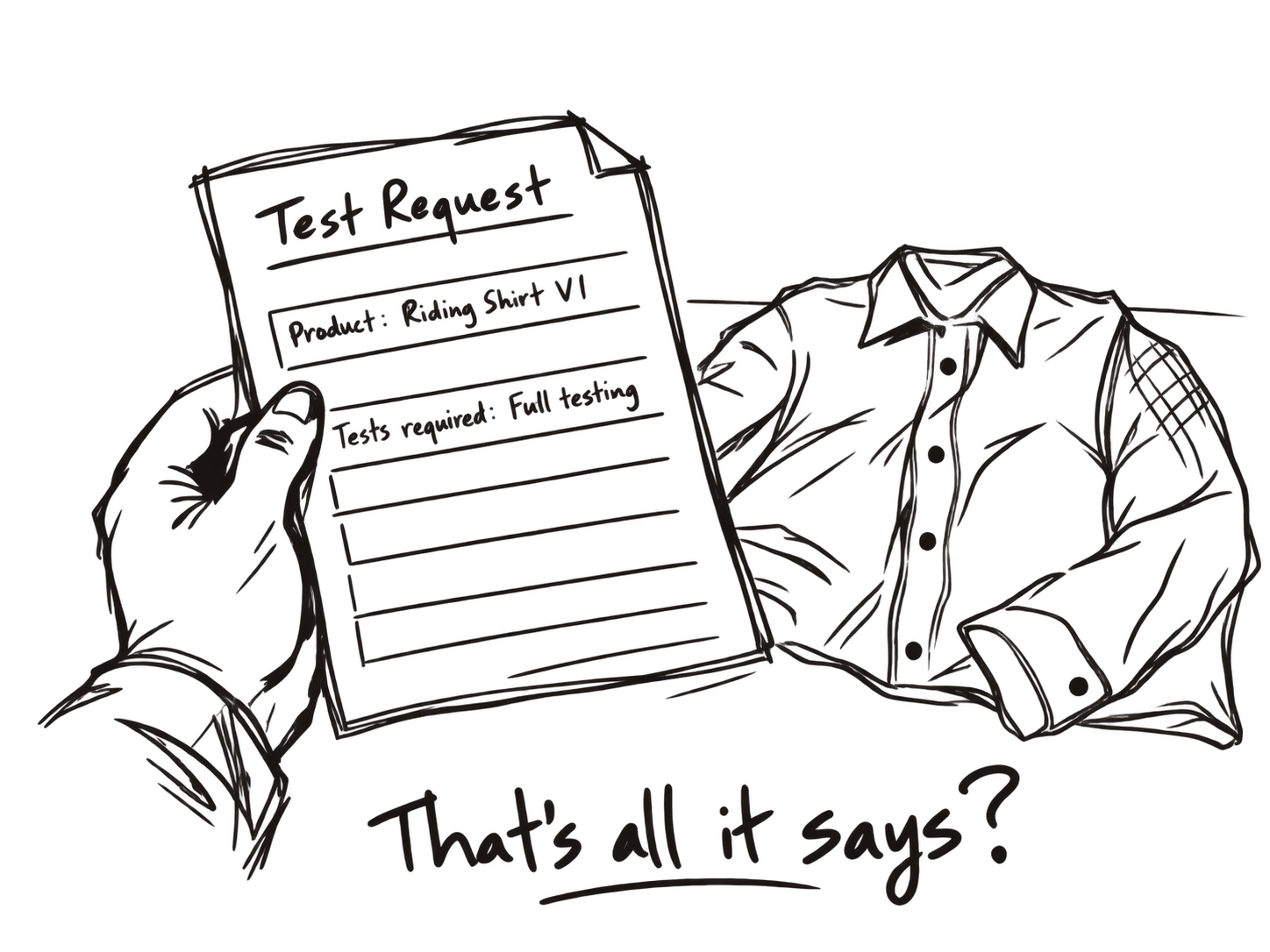
The test request said “Full testing to EN 17092,” on a good day. Sometimes it just said “Full testing.” No construction named, no clause, no seam type, no strong layer. That was the most popular submission sentence I used to see, and it sends a shiver down my spine today. Not just from brands new to this, either. Established names do it too.
Some test house forms do not help much either. I have seen a one-page form with every test clause sat there, ready to tick, that never asked for construction or where the strong layer sits. I have seen a ten-page form asking for more detail than most technical files. Neither extreme gets you a better result if you do not know what to put in the boxes.
The test house is not going to refuse the job. They will book the job in and run it against what you gave them. The report can land four to six weeks later, sometimes longer. What gets tested depends on what you wrote down. Miss a construction, miss a clause, miss the strong layer, and they miss it too.
The strong layer is not always the shell
As standard, they will test your outer shell. The standard itself does not say to start there. From experience, unless you tell them differently, that is where they assume your strongest layer sits, so it is the safe assumption on their side. But the layer that gives a garment its strength, its structural strong layer, does not have to be the outer shell. It can sit anywhere above the skin, whether that is the outer shell, a liner built in and never removed, or built into the impact zones where nobody looking at the outside would know it is there.
If you do not say where your strong layer is, you get a report for a generic version of your product, not the specialist one you built. Only that layer has to pass, whatever it is built from. Every other material on the garment can fail, rip or abrade and it changes nothing, because none of them are what’s between the road and the skin.
If your strong layer sits in the liner, the outer shell being tested alone was probably never designed to carry that pass on its own. That was never its job. Finding and proving your actual strong layer after that first fail means instructing more testing yourself, and paying for it yourself.
The order is not about your budget
Tear and seam strength do not need a class decided first, so those can run early. Abrasion does. You set the class, and the speed the rig runs at gets worked out from that, for the zone the construction sits in, before the test can even start. That is a decision you make, not the test house. It will not be made in whatever order is cheapest for you.
Abrasion is the expensive one. A full set is nine samples across three cycles of three, and a single construction typically runs to over £400 before washes are added. Tear and seam strength cost noticeably less each.
A construction can fail in the first cycle, and the test house may carry on regardless, running the rest of what you asked for on the form. I have seen it happen. They are within their rights to finish everything else on there. Nobody told them to stop. Always specify where you want them to stop, or to notify you at a fail point, or you pay to find out in week six what you could have known in week one. The result still turns up in the full report four to six weeks later. One line: fail.
Not specifying the strong layer costs you long before that point too. Say your strong layer sits in the liner, but you never said so on the submission. The test house tests seam strength on every outer shell seam construction instead, at somewhere between £50 and £100 a time. Five or six outer shell seams is a normal count, and none of them needed testing if your actual strong layer only carries one or two. Tear strength works the same way: two or three outer shell materials, say two different textiles plus a stretch panel under the arms, and all three get tested separately, when specifying the strong layer properly could have brought that down to one tear test on the layer that actually matters. It does not matter how many of those outer materials would have failed on their own. None of them are what’s between the road and the skin. Where the garment has protector pockets or structural closures, they still get tested on their own terms, unaffected by any of this.
Where I come in
None of this needs to happen after the garment is made. Swatches can go in before you cut a single panel, tested in the order that tells you the most for the least money: tear and seam strength first if the class is not settled, abrasion once it is. That is the part I get involved for.
I have seen good submissions and bad ones. My own submission document is built around one question: what does the test house need to see, at the moment of submitting? A test team does not need to scroll through a whole technical file to find that. A concise, complete submission document covers it, and nothing more.
Not because the test house will not help you. They are within their rights to expect a submission that is full and complete. Writing your clauses was never their job. They get paid for a retest. I do not. Do it properly, or you end up exactly here.
If this is not the first garment you have submitted, some of that cost might already be paid. Chemical tests are usually run locally, and your factory often already holds those reports. Check there before you commission them again. Certification bodies vary on what they will accept reused, and it is usually the chemical and mechanical reports rather than anything specific to the product, so some tests will likely repeat no matter how well you plan. Checking what you can reuse is part of getting the order right, not an afterthought.
If a set does fail, having me already on the project means the next question gets an answer instead of a guess: is that construction dead, or is there a change that fixes it without starting over. Send a fail straight to the factory without an experienced team backing you, and the answer is usually “change the material.”
Retest two sets of abrasion on a jacket and you are close to what it costs to have me manage the whole submission from the start. Most of the time, you are paying for the test twice: once for the version nobody specified, and again for the one you needed.
I check test requests before they go anywhere near a test house, as part of managing the whole certification project.